ABB APOW‑02C Medium‑Capacity Backup Power Supply Board
Product Overview
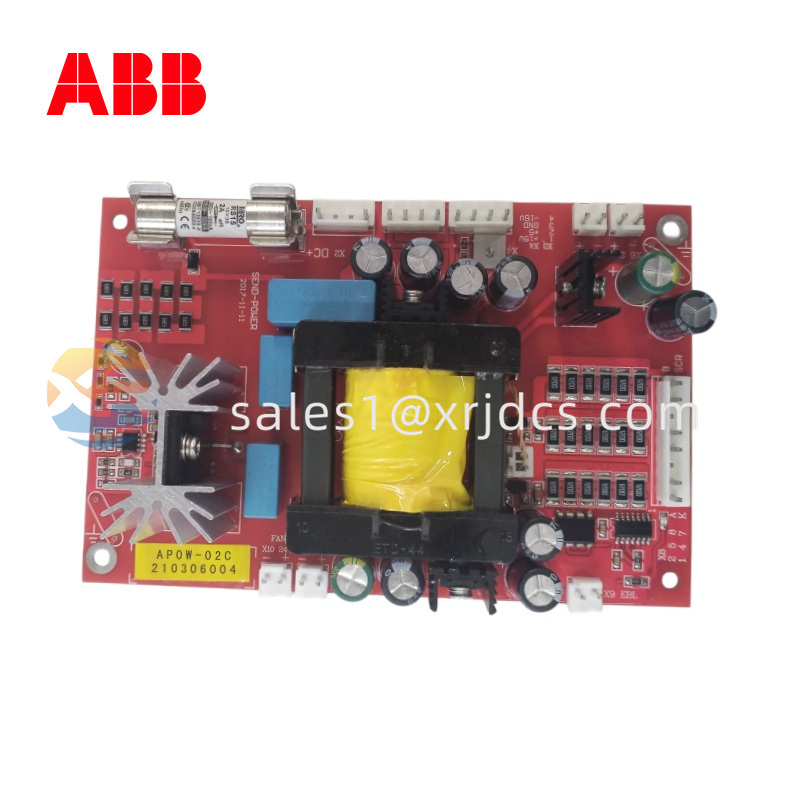
The ABB APOW‑02C is a backup power supply module designed to provide a stable and uninterrupted 24 V DC power source for industrial automation systems. It serves as a redundant power unit that automatically takes over when the main power supply fails, helping protect sensitive control equipment, PLCs, sensors, and communication modules.
This module’s combination of compact design, intelligent switching, and communication capability makes it suitable for embedded control cabinets, laboratory systems, small data centers, and other critical infrastructure sectors where power continuity is essential.
Technical Parameters
| Feature |
Specification |
| Model Name |
APOW‑02C |
| Manufacturer |
ABB |
| Product Type |
Backup Power Supply Board |
| Input Voltage |
24 V DC (from main power) |
| Output Voltage |
24 V DC ±3% |
| Maximum Output Power |
48 W |
| Maximum Output Current |
2 A |
| Battery Type |
Lithium‑ion with overcharge protection |
| Battery Capacity |
4.4 Ah |
| Autonomy Time |
Up to ~4 hours at 1 A; ~2 hours at 2 A |
| Switching Time to Backup |
< 3 ms |
| Communication Interface |
Modbus RTU (RS‑485) |
| Display |
LCD: shows charge status, voltages, diagnostics |
| Operating Temperature |
−10 °C to +50 °C |
| Protection Level |
IP20 (indoor use) |
| Weight |
Approx. 1.5 kg |
| Housing |
Metal with passive cooling |
| Specifications sourced from product listing details. |
|
Functional Structure
The APOW‑02C is designed as a self‑contained backup power module and includes:
-
Main 24 V DC input terminals for connection to the primary power source.
-
24 V DC output terminals that feed connected loads during normal and backup operation.
-
Rechargeable lithium‑ion battery pack with integrated overcharge and over‑discharge protection.
-
Intelligent switching circuitry to manage seamless transitions between power sources.
-
Communication interface board (RS‑485 connector) tied to Modbus RTU for data exchange.
-
LCD user interface for real‑time monitoring at the unit’s front.
Typical Applications
The APOW‑02C is ideal for systems where power continuity and load stability are crucial:
-
Industrial control and automation cabinets
-
Backup power for PLCs and safety systems
-
Laboratory instrumentation requiring uninterruptible supply
-
Small server racks and network power protection
-
Remote data collection and telemetry equipment
Its backup capability ensures that critical control functions continue during short‑term outages and can gracefully shut down noncritical systems when longer power interruptions occur.
Installation & Maintenance
Installation Tips
-
Install the APOW‑02C within a standard industrial enclosure with adequate spacing for ventilation.
-
Wire the primary 24 V DC supply and the protected load to the designated input/output terminals.
-
Connect the RS‑485 Modbus port to the system network for monitoring and control.
-
Ensure proper grounding to minimize electrical noise interference.
Maintenance Recommendations
-
Periodically check the LCD panel for battery health and any fault messages.
-
Inspect terminal connections for oxidation or looseness.
-
Replace the lithium battery according to manufacturer recommendations when end‑of‑life is reached.
-
Keep firmware or communication configurations updated if integrated with system monitoring tools.
Advantages & Benefits
-
Reliable 24 V power backup: Minimizes interruption risks to critical automation loads.
-
Seamless switching: Short transition time prevents control logic resets.
-
Communication ready: Modbus RTU support enables integration with PLC/SCADA systems.
-
Clear diagnostics: LCD helps service technicians quickly understand battery and system status.
-
Compact, rugged design: Suitable for industrial cabinets and harsh environments.
Summary
The ABB APOW‑02C medium‑capacity backup power supply board delivers stable 24 V DC power with automatic failover and extended runtime, making it a valuable power management component in industrial automation and control systems. Its blend of reliability, communication support, and easy monitoring helps ensure systems remain operational even when main power interruptions occur — ideal for PLCs, safety controllers, and other sensitive equipment that depend on continuous power.




 Switzerland
 .jpg)
.jpg)